“There are exceptional people out there who are capable of starting epidemics. All you have to do is find them.” – Malcolm Gladwell, The Tipping Point: How Little Things Can Make a Big Difference. This is about the rise of the Influencer- how it came about and why is someone from their living room able to start a phenomenon?
How many times have you been on a social media platform and seen someone you follow post an item of clothing you like and then go searching for it through the Google rabbit hole? Or, when you are scrolling through your various social mediafeeds you see a fashion trend posted by several you follow and then all of a sudden you are looking to purchase that trend yourself? As much as I like to think of myself as having a unique style I am 100% guilty of this.
Two months ago I hated tie dye patterns. However, after seeing others wearing it on my feed numerous times i found myself once again down the Google rabbit hole searching for a matching tie dye hoodie and sweats. Now ask yourself when is the last time you saw an item of clothing in a banner ad, magazine, or commercial and you thought, “Wow I need this!” I can’t even recall the last product I saw advertised in these platforms- can you?
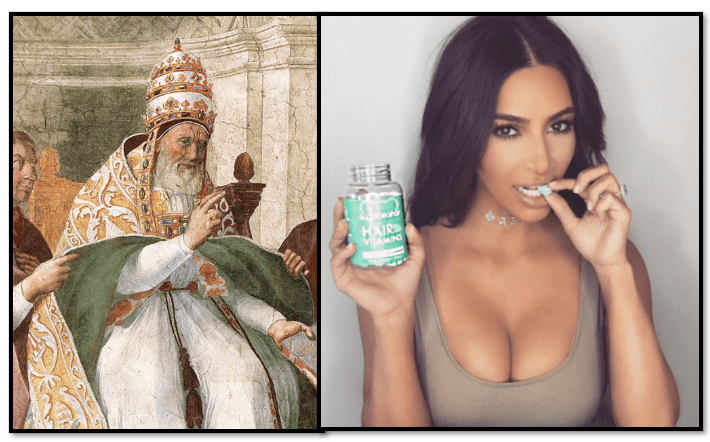
The concept of the Influencer is nothing new. The first known Influencers date back to the Middle Ages in which the Pope and the royal families used their “influence” on their subjects in order to promote the earlier uses of medicine to the masses. It is important to note that it was believed Medieval royalty had the divine right to rule, and the only person above them was the Pope (who was believed an still as by many to be God’s earthly representative). This belief allowed them to influence on a massive scale- imagine if they had billboards, commercials, radio spots, and even modern day social media platform access?
Enter in the Industrial Revolution in which products could be produced faster than every before- the public finally had choices! How would they make the right choice or believe they did? You got it- Influencers. In 1760, Josiah Wedgwood, after making a tea set for Queen Charlotte dubbed himself “Potter to her majesty.” One could argue he was the first person to use an Influencer to promote a commercial product.
Enter into the 1900’s Murad Cigarettes featured film star and comedian Roscoe “Fatty” Arbuckle in their print ads, making him one of the first celebrities to publicly endorse a product. This is when the influence skewed away from the divine and to the concept of the celebrity. The celebrity moved away from royalty and the religious leaders and towards a film star. How did this change happen? Simply because they SAW the celebrity more; had more access to him. The more exposure someone had (enter in the advent of media technology) the more reach and influence they had. One could argue that movie goers were the 1900’s version of “followers.”
Throughout the 20th century, you saw the rise of the celebrity and in direct correlation the rise of the celebrity Influencer. Why were the Influencers celebrities (actresses, models, musicians)? Simply put they were more accessible. Who do you think would influence your style more- Farrah Fawcett who is in your living room once a week? Or would it be the random ad you saw in Vogue? Or the commercial you saw for Jordache Jeans? Most likely, you wouldn’t want to buy something you have seen once. Accessibility = Influence.
Enter into the latter portion of the 20th century and the celebrity influencer and the concept of “sex sells” was never more prevalent. All you need to see is the Britney Spears Pepsi commercials and the Brooke Shields Calvin Klein ads as examples. So now celebrity + perceived sexiness is the go-to formula. While the platforms have changed the message unfortunately has stayed the same.
Reality television of the 1990’s and early 2000’s had us enter into the “real lives” of people. This was the 1st time a “real” person; not a typical celebrity (actress, musician, model, etc.) had a reach to the masses. The concept of “famous for being famous” was all the rage (enter in the Paris Hilton era). We all saw “real” people living these glamorous lives and clearly we all wanted to be a part of it- do we all remember how fast the Juicy Couture track suits sold out?
Fast forward to today in which anyone can promote themselves on the many social media platforms now available to us. Social media allows us to get a peek into someone’s else’s life and Influencers use this to subconsciously endorse products to their mass followings. We see someone living their every day life and their life in the social media world seems glamorous and perfect. We would all like to think we are not fooled by this but the money these Influencers make clearly proves us otherwise.
It’s the same formula as it was from the beginning- if you do this you will be like me. Whether it’s aspiring to be royalty, or as masculine as the Marlboro man was perceived at the time, Britney Spears, or even the Kardashians the concept is still the same. While our technology has evolved the influence our “betters” have over us has sadly not.
As of recently times are changing though. The 2017 Millennial Shopper Survey by DealSpotr found that 52% of Millennials don’t trust Influencers anymore. Social media Influencers are thought to be no longer authentic- while they 1st started by giving us a glimpse into their life and subconsciously promoting brands they had turned into openly promoting brands and altering photos so much that they could not be mistaken for “real” life. Influencers have made the switch from enthusiastic amateur to professional brand ambassadors/photographers/content producers and the overall population are finally starting to notice.
So next time you are itching to buy a tie dye sweat suit just think to yourself- “Is this me? Why do I like this?” This type of thinking would have saved me $100 and 10 embarrassing selfies of myself trying to make said sweat suit look glam. Just thankful I did not post this and influence anyone else to this “fashion hot trend.”
 Fashion HerStory